Dog Watercolor Clipart: Cute Puppies Illustrations
Evaluating Whimsy for Artisan Pet Bakery Branding
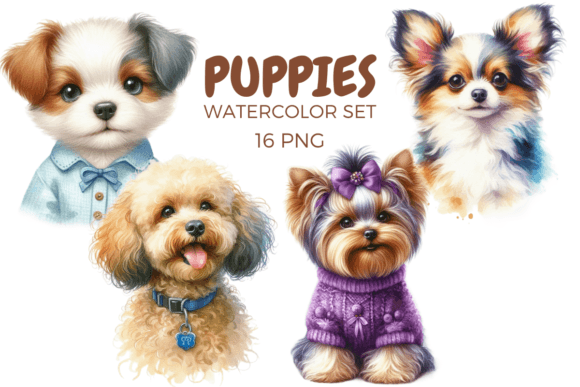
As a brand designer specializing in local business identity, my first interaction with any graphic design asset is always a critical stress test. When reviewing the Dog Watercolor сlipart, Cute Puppies collection for a recent project involving an artisanal pet bakery and grooming boutique, I looked past the immediate charm to assess functional viability. The initial impression of these illustrations is undeniably soft, nostalgic, and approachable. The watercolor medium suggests a handmade, organic quality that aligns perfectly with small businesses emphasizing natural ingredients or personalized care. Unlike rigid vector art, the bleeding edges and textured washes of this clipart evoke warmth and trust, signaling to customers that the brand is friendly rather than corporate. For a local business owner, this mood is essential; it bridges the gap between professional polish and community connection.
However, aesthetic appeal must translate to commercial utility. In evaluating this specific set of Dog Watercolor сlipart, Cute Puppies, I found the style leans heavily into "cottagecore" and gentle modernism. It avoids the overly cartoonish look that can sometimes cheapen a brand, instead offering a refined playfulness suitable for premium pricing. This distinction matters significantly when designing for discerning pet owners who view their animals as family members. The asset feels bespoke, making it an excellent candidate for businesses that want to avoid generic stock imagery while maintaining a cohesive visual narrative across physical and digital touchpoints.
Translating Clipart into Tangible Packaging Design
The true value of any design assets collection lies in its application. For the pet bakery project, we utilized Dog Watercolor сlipart, Cute Puppies as the primary visual anchor for packaging design. Specifically, individual puppy portraits served as flavor identifiers on treat bags—a Golden Retriever for peanut butter flavors and a Beagle for savory biscuits. This created an intuitive visual hierarchy where customers could identify products by color and breed association before reading text. The transparency of the PNG files allowed us to layer the illustrations over kraft paper textures and pastel backgrounds without awkward white boxes, ensuring the product label felt integrated rather than pasted on.
Beyond packaging, these illustrations proved versatile for secondary branding elements. We extracted smaller paw prints and bone motifs from the set to create custom patterns for tissue paper and sticker seals. For social media graphics, the clipart provided ready-made focal points for Instagram announcements and Facebook ads, reducing the need for expensive product photography during the launch phase. The consistent artistic style meant that a thank-you card inserted into a shipping box matched the website banner perfectly. This consistency is the cornerstone of effective small business branding; it builds recognition and reinforces the customer's purchasing decision through repeated, harmonious visual cues.
Strategic Placement for Maximum Shelf Appeal
Knowing where to place Dog Watercolor сlipart, Cute Puppies is just as important as knowing how to use it. In our testing, these illustrations performed exceptionally well as hero graphics on storefront signage and seasonal promotional flyers. The emotional resonance of the artwork draws the eye from a distance, making it ideal for farmers' market displays or boutique window decals. For marketing visuals, the clipart works best when given breathing room; the watercolor texture needs space to be appreciated. We found it particularly effective on matte finishes, where the softness of the print mimicked the original painted medium.
Conversely, there are areas where caution is required. I would advise against using these detailed illustrations on very small labels, such as ingredient stickers or regulatory compliance tags. The intricate brushwork can become muddy at reduced sizes, compromising legibility and professionalism. Similarly, for luxury minimalist brands that rely on stark typography and negative space, this level of decorative detail might compete with the intended sophisticated silence. In editorial design or dense informational layouts, the clipart should serve as a subtle accent rather than a dominant force to prevent visual clutter. Always prioritize readability and information architecture over decoration.
Technical Vetting for Professional Commercial Use
Before committing Dog Watercolor сlipart, Cute Puppies to a final brand identity system, a rigorous technical evaluation is non-negotiable. As a designer, I always test assets in grayscale first. If the illustration relies solely on color contrast to define form, it will fail in single-color printing or embossing applications. Fortunately, this set maintained good tonal separation in black and white, making it viable for receipt tape printing and newspaper ads. I also recommend testing the asset alongside your chosen typography. Pairing these soft illustrations with a structured sans-serif font creates a modern balance, while combining them with a handwritten script enhances the rustic, handmade feel. However, pairing them with an ornate serif can sometimes result in a visually heavy design that lacks clarity.
File integrity is another critical checkpoint. When sourcing from a creative marketplace, always verify the resolution. For product mockup presentations and large-format printing, 300 DPI is the minimum standard. I inspected the PNG transparency masks closely; clean edges are vital for overlaying on colored backgrounds. Jagged pixelation around the fur details is a common issue with lower-quality watercolor scans and can instantly devalue a commercial design. Furthermore, if you plan to scale the artwork significantly for wall murals or vehicle wraps, check if SVG versions are available or if the raster files are high-resolution enough to withstand enlargement without artifacting.
Licensing and Long-Term Brand Viability
Perhaps the most overlooked aspect of using digital assets is licensing. Before using Dog Watercolor сlipart, Cute Puppies for any client work or physical product sales, confirm the commercial license terms explicitly. Some licenses cover digital marketing but restrict physical merchandise, or require attribution that isn't feasible on small packaging. Understanding these boundaries protects your business from legal issues and ensures ethical support for the original artist. Additionally, consider the longevity of the style. While trendy aesthetics can boost short-term engagement, professional branding requires assets that won't look dated in two years. The classic nature of watercolor animal portraiture generally offers better staying power than hyper-stylized vector trends, making it a safer investment for long-term local business growth.
Ultimately, integrating Dog Watercolor сlipart, Cute Puppies into a brand strategy requires balancing emotion with execution. When used thoughtfully, it transforms generic products into cherished items, fostering a deeper connection between local makers and their community. By treating this clipart not just as decoration, but as a strategic component of visual hierarchy and brand storytelling, small business owners can achieve a polished, professional presence that rivals larger competitors. The key lies in intentional placement, technical diligence, and a clear understanding of how whimsical art serves serious business goals.